

Some teenagers get excited to go back to school. They want to see their friends and resume after-school activities. However, it’s also very common for parents and teens alike to feel nervous about the new school year. You might worry about academic stress, bullying, peer pressure, money, or your kids being in an environment you can’t control.
If so, you may want to check your own nervousness first. Kids and teens notice adult moods quickly. They pick up on them, and they may copy some of the same feelings and actions. Regardless, back-to-school anxiety is common. It’s usually temporary, but in some instances, it signals something bigger. How do you know when to get help?
Back-to-school anxiety can look a lot of different ways – headaches, irritability, excessive worry about the first day back, changes in eating habits, withdrawal, or avoidance. It happens for various reasons. Finding the underlying cause and addressing it is essential.
When it’s more than just the back-to-school jitters, the problem may not go away on its own. In that case, it’s important to seek mental health support for your teen. This is our guide to back-to-school anxiety for parents.
What Is Back-to-School Anxiety?
Back-to-school anxiety is usually a normal stress response to a new year and changes in routine. It’s not a diagnosis, and it is not the same as a clinical anxiety disorder. Mental health conditions are ongoing. Standard back-to-school anxiety is situational and time-limited.
It can appear before a new school year, but anxiety about going back to school after a break of any kind can happen. It could be Summer, holidays, or vacations. It’s also common for kids to go through back-to-school anxiety in high school; entering higher grade levels (e.g., junior or senior year) or making the transition from middle school can be a major shift.
Signs of Back-to-School Anxiety in Teens
Some signs of back-to-school anxiety are more covert than others. They can be physical, emotional, and/or behavioral.
Physical signs
Some teens are prone to physical symptoms of anxiety. They can vary from person to person but often include:
- Stomach aches
- Headaches
- Sleep disruption
- Appetite changes
These often pair with emotional or behavioral signs.
Emotional/behavioral signs
Emotional and behavioral signs of back-to-school anxiety in teens may include:
- Irritability
- Withdrawal (shutting down, isolating socially)
- Excessive worry about the first day
- Avoidance (e.g., “I don’t want to go to school,” “I want to pretend it’s not happening”)
In teens specifically, look out for signs like irritability or shutdown rather than the visible clinginess seen in younger kids. It can be easy to chalk irritability to “teens just being teens,” but it is very much a potential anxiety symptom, too.
Why Do Teens Get Anxious About Going Back to School?
Sometimes, the reasons for back-to-school anxiety are more obvious than others. Here are some of the most common things our clinicians notice.
Social pressure
Social pressure can take many different forms. For example, re-entering friend groups, social hierarchy shifts, or the fear of not fitting back in.
Academic pressure
For some kids, academic pressure can be a serious issue. This can be true for very high-achieving children and those who struggle to complete classwork or may even have a concern like a learning disability or mental health condition. It might be workload anticipation, fear of falling behind, or grades.
Routine disruption
Routine disruption might make teens feel nervous or sad. Sleep schedule, changes in daily routines or activities, or the loss of summer freedom can be an adjustment.
Underlying anxiety or depression
Back-to-school anxiety can, at times, be a trigger point that surfaces a pre-existing condition. This is when it’s not just a matter of back-to-school jitters. If a teen already has a mental health condition of any kind, depression or otherwise, times of change or stress can make symptoms “spike.” Back-to-school depression is just as real as back-to-school anxiety. Sometimes, they go together.
How to Deal With Back-to-School Anxiety: Practical Tips
There are ways to help your teen navigate back-to-school anxiety. Here are some things you can do before, during, and after those first couple of weeks back.
Before school starts
It’s a good idea to prepare before school starts if you can. Work with your child to shift their sleep schedule in the 1-2 weeks prior if needed. Ask your child’s school if it’s possible to visit the school and walk through their schedule for the new year. It can be good to see the school when it’s quiet.
If they have specific concerns, talk openly. Address the specific topic rather than giving generic reassurance. Rather than “you’ll be fine” or “we all had to do it,” ask your teen to tell you more about what makes them not want to go back. Is it other kids? Waking up early? Schoolwork? The transition from middle school to high school? Entering senior year? Body image? A falling out with a friend?
Teens should feel supported and embraced. You can communicate that you love watching them grow into who they are, that things can be hard in school and in life, and that you are there.
The first week
Keep mornings predictable. Waking up at the same time each day and following a morning routine as they get ready for school can create a sense of reliability and reduce the need for decision-making. Check in daily without interrogating. Some teens open up more than others. Validate feelings without over-accommodating avoidance. Be empathetic while setting boundaries (“I can’t let you stay home, but I understand how big of a deal this is. I am here to listen and help you find solutions.”)
Ongoing
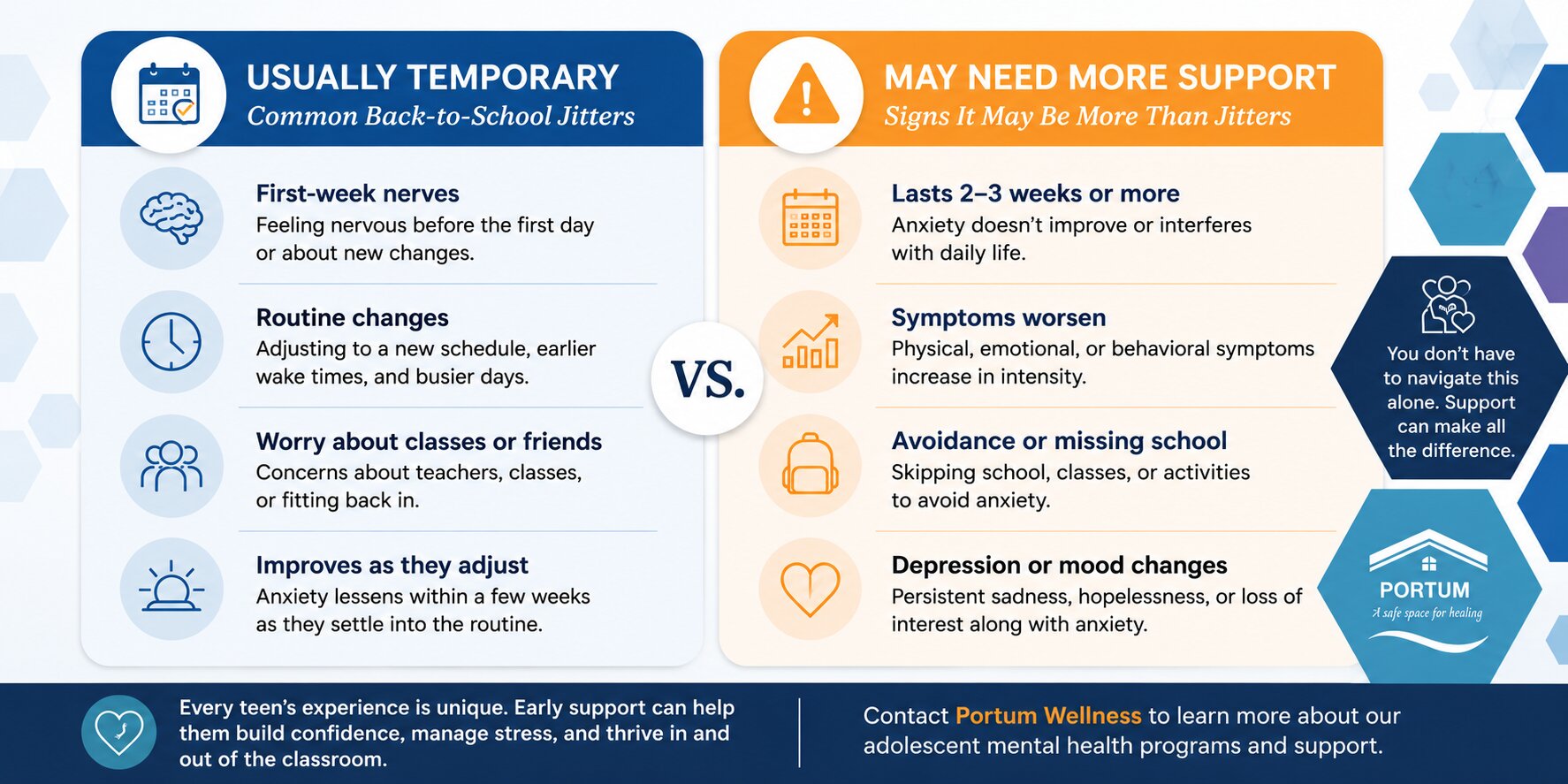
Notice whether your child’s symptoms go away within two weeks. If they continue beyond that point, loop in the school counselor early. When anxiety symptoms become a pattern rather than a matter of one bad day, it is a sign that back-to-school anxiety is more than just the jitters and could affect your teen’s quality of life. A 504 plan could benefit your teenager if they have an anxiety disorder.
When Back-to-School Anxiety Is More Than Just Jitters
It can be hard to sort through what’s just the jitters vs. what’s not. Parents usually have good intuition about this, but it can be difficult to know what to do. Look out for signs that it’s becoming something bigger, and understand that getting help now is something that will set your teen up for success in the future.
Signs it’s becoming something bigger
How do you know if back-to-school anxiety could be something bigger?
- Anxiety lasting more than 2-3 weeks into the school year
- Physical symptoms escalating rather than fading
- Avoidance turning into actual missed school days (school refusal)
- Signs of depression alongside the anxiety (low mood, hopelessness, loss of interest)
An evaluation from a caring teen psychiatrist can help teens and families understand what’s going on and point them in the right direction for treatment if the results indicate the need for professional support.
Why this matters for teens specifically
The developmental stakes are higher in adolescence. Academic and social setbacks compound faster. Untreated anxiety at this stage typically needs more than “getting used to it.” Teens may develop unhealthy coping mechanisms for concerns like anxiety disorders that go unaddressed, and often, anxiety becomes more severe the longer it goes untreated. It is best not to let the anxiety grow. Treating it now prevents serious impacts on quality of life and functioning later. Therapy for anxiety in teens leads to reduced symptom severity and healthy tools for management.
When to Consider Professional Support
Most back-to-school anxiety resolves within a few weeks with routine and reassurance. If it’s not resolving, or if it’s tangled up with depression, trauma, or substance use, outpatient treatment may be the right next step. We have an adolescent-only (13-18) program for teens navigating a range of mental health concerns. This includes anxiety-specific programs, with treatment options including:
For teens with co-occurring substance use, there’s no wrong door. Entering either treatment path can get your teen help for co-occurring disorders. Early intervention is important for youth misusing substances. It can prevent the worsening or development of substance use disorders.
Conclusion
Back-to-school anxiety is common and usually temporary. The goal isn’t to eliminate all anxiety. Instead, it’s to know the difference between normal adjustment vs. something needing more support. Early attention prevents small stress from becoming a bigger problem. The goal is to teach teens to manage anxiety, life stress, and transitions in a healthy way.
Contact Portum Wellness for a Free Confidential Assessment
If you’re concerned that your child may have more than the back-to-school jitters – or if anxiety symptoms have persisted beyond the two-week mark – you might wonder what to do next. Portum Wellness offers PHP, IOP, and virtual IOP for teens. These programs provide flexible care for concerns like anxiety. Teens in IOP and virtual IOP can balance school with therapy.
Whether you’re ready to begin admissions or have a question, we can help. Call (551) 368-5648 to reach Portum Wellness for a free, confidential assessment for your teen today. You can also verify insurance online for treatment.
Frequently Asked Questions (FAQs)
How do I calm my teen’s back-to-school anxiety?
First, listen to your teen without offering a solution. Make sure they feel heard and understood first. Adjust their sleep schedule and morning routines early, and see if you can visit the school together before the new year starts. Face fears directly; work with them to find solutions, and if they need more support, talk to the school counselor or seek mental health support outside of the school.
How long does back-to-school anxiety usually last?
About 1-2 weeks or less of back-to-school anxiety can be expected and is completely normal. Anxiety beyond that point means that there’s likely more to address.
Is back-to-school anxiety different from school refusal?
Yes. Not all teens necessarily experience school refusal alongside back-to-school anxiety, though the two often go together.
Can back-to-school anxiety turn into depression?
Yes. Back-to-school anxiety can turn into depression. Seeking professional support can help.
My teen is anxious about going back to school after a break, not just at the start of the year — is that normal?
Yes. Anxiety about returning to school can happen after time off for any reason, whether it’s months in the Summer, a couple of weeks in the Winter, or after an event like a vacation, time abroad, or a medical leave.