

If you’re reading this, you know what school refusal is. You likely already know or suspect the reason for your teen’s school refusal. You’re past the “why is this happening?” stage. Now, you want to find out what to do about it. Portum Wellness & Recovery provides compassionate care for teens and adolescents. This piece will cover what a structured, evidence-based treatment approach for school refusal in teens looks like, step by step.
Learn more about school refusal in teens.
What Makes a School Refusal Treatment Plan Effective?
What makes a school refusal treatment plan for teens effective? School refusal intervention plans must involve:
- An effective school avoidance treatment plan involves three parties working together: The family, the school, and clinicians (e.g., therapists). Parent involvement is a critical part of successful treatment.
- Evidence-based care. Cognitive Behavioral Therapy (CBT) based interventions show strong response rates for teens experiencing school refusal. Studies show that about 70% of kids respond positively. A recent meta-analysis found it effective in 80% of studies.
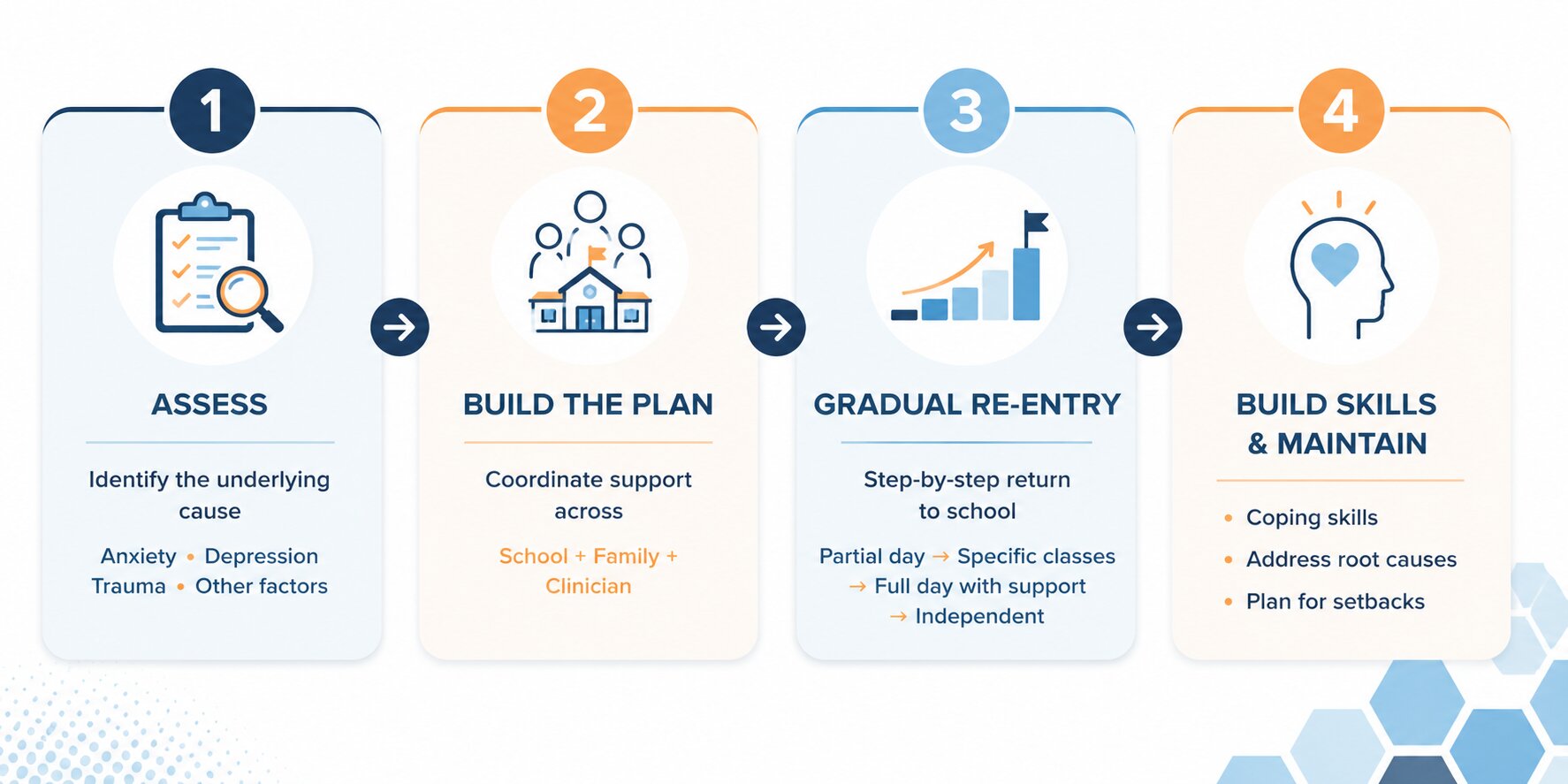
A school refusal treatment plan should also follow specific phases. These include assessment, building the plan, gradual re-entry, and teaching the teen coping skills that lower distress and support maintenance.
Phase 1: Assessment
If it has not already happened, the first step is to complete the assessment phase.
Identifying the underlying driver
What’s the reason for your child’s school refusal? Common concerns we notice that lead to school refusal in teens and adolescents include:
- Anxiety
- Depression
- Trauma
- Autism
- Substance use
Sometimes, multiple factors are at play. A professional, such as a child and adolescent psychiatrist, can provide a comprehensive evaluation for mental or behavioral health concerns like depression or anxiety that may contribute to school refusal. They’ll go over your child’s personal history in-depth and rule out other possible symptom causes.
The School Refusal Assessment Scale (SRAS)
The School Refusal Assessment Scale (SRAS) is a clinical tool consisting of 24 questions. Answers to the questions on the SRAS from parents and teens are used to identify which of four functions is driving the avoidance: avoiding distress, escaping social/evaluative situations, seeking attention, or seeking tangible rewards outside school. Identifying the reason(s) for school refusal matters. It is a key part of building an effective treatment plan, which should always involve care and support for the underlying cause.
Phase 2: Building the Plan (School + Family + Clinician)
School accommodations, changes at home, and therapy are the three core elements of a school refusal treatment plan for teens.
Setting up the school-side plan
Some kids will benefit from an individualized education plan (IEP) or 504 plan for anxiety or another concern, such as autism spectrum disorder. In this case, clinicians, school staff, and family will meet to work out the details. IEP plans are renewed annually, with a full re-evaluation happening every three years. 504 plans don’t have strict federal timelines but usually follow a similar schedule.
Identify your main point of contact at your child’s school, even if they do not need an IEP or 504 plan. This could be a school counselor or another trusted staff member.
Setting up the home-side plan
What you do at home will help set your teen up for success. Here are a few things we recommend.
- Morning routine structure (waking up at the same time each day, personal hygiene tasks, breakfast, etc).
- Reducing secondary gains from staying home (e.g., video games).
- Consistent expectations.
Follow-through is essential. Mental health professionals can support you if you need help creating a plan for the home side of things.
Setting up the clinical side
CBT, a non-invasive type of talk therapy, is a first-line treatment for school refusal. For some teens, such as those with underlying anxiety, exposure-based approaches can be key. These help people face their fears steadily and reduce distress. We pair family therapy involvement with individual therapy for the child to increase harmony, understanding, and communication.
Phase 3: Gradual Re-Entry
Gradual re-entry is the most effective way to help teens re-enter school.
Why gradual beats all-or-nothing
Exposure hierarchy is a concept used in therapy for concerns like anxiety. It involves starting with lower-stakes (e.g., less anxiety-inducing) steps and building up gradually. For example, in therapy for social anxiety, a provider using exposure therapy might start by helping a person in their care try a short, small social situation at first, as opposed to a big party.
In the case of school refusal, this involves gradual re-entry, which begins with a less intimidating step like partial day attendance. This beats all-or-nothing because it is more likely to work. Distress from all-or-nothing approaches can be very high, which can reinforce school refusal.
What a gradual re-entry plan can look like
What’s an example of a gradual re-entry plan for school refusal? It might go something like this: partial day attendance → specific class attendance → full day with support → full day independent.
However, this should be individualized. It’s not a one-size-fits-all template. Every teen’s hierarchy looks different. In the early stages of treatment, we will explore what makes them the most and least nervous or distressed. This will help determine what re-entry should look like, step by step.
Phase 4: Skill-Building and Maintenance
In phase 4, we address the root cause of school avoidance and set teens up for long-term success.
Coping skills that support the plan
In therapy, your child will learn coping skills that support their re-entry plan. Anxiety management strategies like breathing techniques and cognitive reframing (challenging and modifying negative or unhelpful thoughts) are common examples of effective coping skills for teens. This is an example of what we might work on during groups and one-on-one therapy sessions in a program such as our intensive outpatient (IOP) program.
Relapse prevention
Setbacks are common when treating school refusal or avoidance. They don’t mean the plan failed. Don’t take it as a sign to stop trying. It generally indicates the need for more support, not a hands-off approach. This is something we see often. School refusal treatment plans should include a response protocol for bad days so parents have the tools to navigate a relapse in school refusal behavior upfront.
When a Home-and-School Plan Isn’t Enough
Some teens need more structure than a school-based plan alone can provide. In this case, moving up to a higher level of care is the next step. This is usually a partial hospitalization program, also called partial care (PHP), or an intensive outpatient program (IOP). Here are some signs that it is time to escalate care for your child:
- Daily crisis (e.g., consistent emotional distress that is not improving)
- Weeks of non-attendance
- Worsening depression or anxiety symptoms alongside the refusal
Portum’s adolescent-only outpatient programs provide flexible care for 13- 18-year-olds. We offer PHP, IOP, and virtual IOP to make treatment accessible for those with a wide range of needs. There’s no wrong door when it comes to the treatment path you discuss with us. If there’s co-occurring substance use and anxiety, for example, either program will address both because of our commitment to integrated care.
Conclusion
An effective school refusal treatment plan is phased and individualized. It should involve school professionals, family members, and clinicians who work together as a team. Teens should not be forced into a full return. Gradual reentry is the best, most evidence-based approach. If a plan isn’t working, it’s a signal to increase your child’s support – not give up. We know this can be frustrating and challenging for parents and are here to help.
Get Compassionate Support for School Refusal in Teens – Book a Free, Confidential Assessment at Portum
Portum Wellness & Recovery offers teen and adolescent PHP, intensive outpatient (IOP), and virtual IOP. Our trauma-informed team in New Jersey works with a wide range of mental and behavioral health concerns affecting young people aged 13-18. We are here to help your family build a school refusal treatment plan from a compassionate, whole-person lens.
Call us at (551) 368-5648 for a free, confidential assessment for your teen. You can also verify insurance for your child or begin admissions online now by requesting a verification call through our website.
Frequently Asked Questions
What is the best treatment for school refusal?
CBT is an effective therapy for school refusal, but a comprehensive treatment plan is important. It should involve therapy, gradual re-entry, applicable school accommodations, and support at home in the form of structured routines, fewer things that may promote the desire to stay home, and consistent expectations. If there are multiple concerns (e.g., anxiety and co-occurring substance use), all of them should be addressed.
How long does a school refusal treatment plan take to work?
It depends. Returning to a full, stable school routine often takes around 3-6 months, though this can always vary depending on the individual child. If it is mild and caught early, treatment plans usually take less time.
What is the School Refusal Assessment Scale?
The School Refusal Assessment Scale is a written questionnaire that helps identify why kids and teens aged 5-17 avoid school. This is important because it helps to determine the underlying cause of school refusal.
Can a school refusal treatment plan work without a 504 or IEP?
Yes. School refusal treatment can work without a 504 plan or IEP, though they can be very helpful and are important parts of treatment for some. Whether a child needs a 504 plan or IEP as part of their school refusal treatment plan depends on their unique situation.
What should I do if my teen’s treatment plan isn’t working?
Talking with a professional can help you explore the right next steps for your unique child. Depending on what’s going on for your teen, an outpatient program that provides structured therapy for the underlying cause of school refusal may be ideal. In some cases, individualized education plans, 504 plans, or alternative schooling options can be key for teens experiencing school refusal.